Taste, Lift, Fold: The Three-Stage Stir That Saves a Steamed Noodle Box
There is a moment, about forty seconds after the lid comes off a takeaway noodle box, when most people make the same mistake. They plunge a pair of chopsticks straight through the middle, stir like they are mixing cement, and turn a carefully built bowl into a uniform warm mush. It is not a crime. It is just a waste.
The first stir should be a decision, not a reflex. Especially in November 2026, when the box has spent ten minutes steaming on the walk home and the layers have had time to settle, soften and swap places. A V10-style bowl — big broth, fast flavours, no fuss — can survive a commute. But it needs you to mix in the right order.
Before You Stir, Taste the Broth
Open the lid. Do not stir. Let the steam clear for a second, then taste a spoonful of broth from the edge, where it has not been contaminated by chilli oil, pickles or crispy bits.
This is your baseline. Is it salty enough? Does it need a squeeze of lime? Is the heat already sitting where you want it? If you mix first, every later adjustment is guesswork. You end up adding soy to a bowl that was already seasoned, or chilli to something that only needed acid.
On a cold night, the broth is also the part that has suffered most in transit. It has been trapped under a lid, condensing and diluting. Tasting first tells you whether the bowl needs a small rescue — a splash of hot water, a pinch of salt, a dash of vinegar — before the noodles and toppings get involved.
Lift the Noodles, Do Not Saw Them
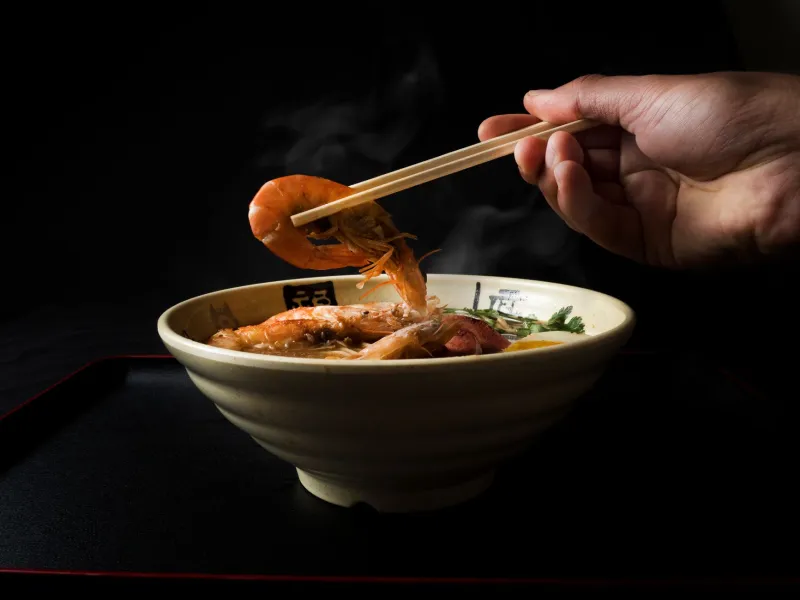
Once you know your broth, go for the noodles. But go underneath. Slide chopsticks down the side of the box, grip a bundle, and lift it up and over rather than stirring through.
This does two things. First, it separates noodles that have clumped together during the walk home. Second, it coats them in broth without crushing the toppings that are sitting on top.
A sawing motion drags everything into the middle and breaks up the crispy elements before they have had a chance to do their job. A lifting motion keeps the architecture of the bowl intact for a little longer. You are not being precious about it. You are just giving the noodles a chance to warm through evenly while the crunch stays where you put it.
If the noodles still feel stiff, leave them for another minute. Takeaway boxes hold heat well. A gentle lift now and then is better than an aggressive stir that turns the whole thing into a single temperature and a single texture.
Stage the Toppings Like They Matter
Toppings are not a garnish. They are the parts that make each mouthful different. Treat them in stages.
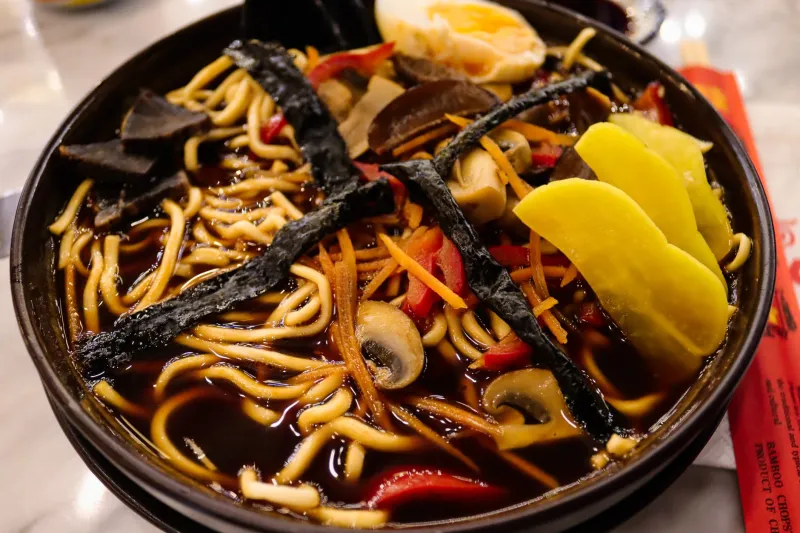
Start with the dense, savoury things: braised mushrooms, tofu, sliced pork, whatever protein has been sitting in the bowl. Fold these gently into the noodles so they get warm and coated, but keep them in relatively large pieces. You want to recognise them later.
Next come the pickles and fermented bits. These need a little contact with the broth to soften their edge, but not so much that they disappear. Tuck them into the sides of the bowl rather than stirring them through the middle. That way you can still find a sharp, bright mouthful when the richness starts to build.
Then the crunchy layer. Crispy shallots, crushed peanuts, fried garlic, bean sprouts, spring onion. These go on last, and they go on top. Do not stir them in. Let them sit there and use your chopsticks to pick up a few with each lift of noodles. The steam will soften them slowly, which is fine. What you are trying to avoid is the full submersion that turns crunch into sad, soggy debris.
Chilli Oil Is a Finishing Move
If your bowl came with chilli oil, do not dump it in at the start. Taste the broth first. Add a little oil to one side of the bowl, not the whole thing. Then lift noodles through that side for a few bites and see how the heat builds.
This is especially useful on a takeaway night when you are not sure how hot the kitchen has gone. A V10-style bowl should have heat you actually want, not heat you endure. Staging the chilli lets you find your own line rather than having it drawn for you.
The Last Bite Should Still Be Interesting
The test of a good mixing order is the bottom of the box. If the final mouthful is a warm, uniform sludge, the stir was too early and too rough. If it still has a bit of crunch, a bit of acid, a bit of savoury depth and a broth that tastes like something, you have done it properly.
So next time the lid comes off, wait. Taste the broth. Lift the noodles. Fold the dense toppings. Tuck the pickles. Finish with crunch and chilli. It takes about ninety seconds longer than a frantic stir, and it makes a November takeaway feel like a bowl that was built for you rather than a box that happened to survive the walk home.